-
A business is a living system, not a machine.
You don’t assemble it, you grow it — and it lives or dies on the part you can’t see. Every other belief here follows from that one. The long version is here.
-
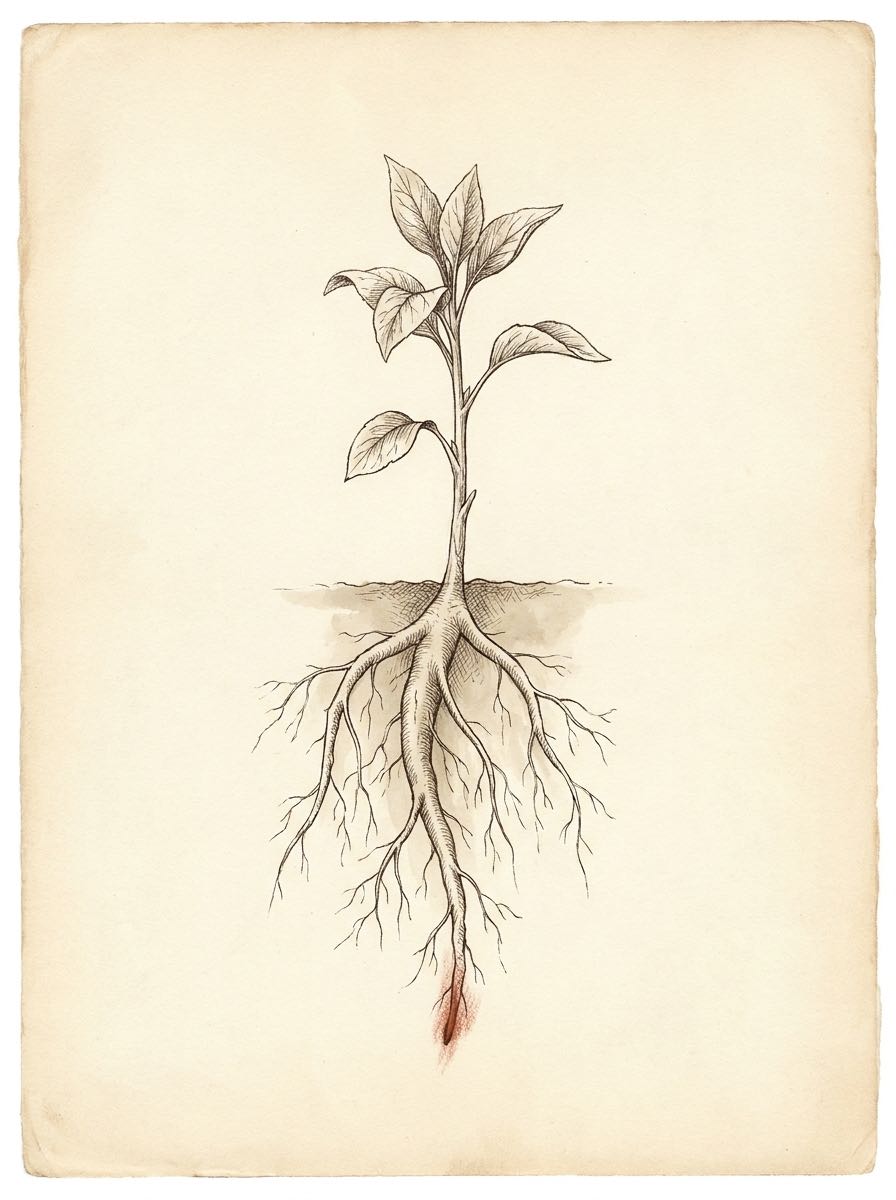
The business of your business is decided underground.
The busyness, the missing money, the captivity — none of it starts where you’re looking. It starts in the formation docs, the terms, the cash rhythm. Read the soil, not the flower.
-
If you let them, they will let you die at your desk.
“They” being either the people you work with and for, or yourself. Nobody is coming to make you stop. That’s not cruelty; it’s just how it goes if you don’t build the structure that does.
-
Success and captivity arrive in the same motion.
The business working is the prison. Real clients, real revenue, and you can’t get married, can’t see the kids play, can’t turn down work you don’t even want. Nobody warns you that those come as a pair.
-
A founder-dependent business is a cut flower.
It looks alive. It has no roots. It has been dying since the day it bloomed — slowly enough that you can spend twenty years watering the vase and calling it gardening.
-
Ease is the real KPI.
A business is doing well when it generates ease — for everyone inside it, the owner included. Revenue is a mushroom count. I’m the ease person, not the high-profit person, and I say so on purpose.
-
Enough is a legitimate business goal.
A company that pays you well, runs without breaking you, pays everyone in it as well as it pays you, and could be sold someday is not a consolation prize. It’s the thing most founders actually wanted before someone told them more was the only acceptable direction.
-
The money is rarely missing. It’s buried.
In an established business it’s almost never “sell more.” It’s earned-but-never-collected, priced years below its worth, promised on terms nobody enforces. The treasure is in the exact drawer nobody wants to open.
-
Expertise in the thing is not health in the business of the thing.
I once worked beside a brilliant specialist — one of the best in the world at a very hard, very technical thing — who could read the numbers of any business except his own. No founder gets to feel stupid about this. And no founder gets to skip it.
-
A lesson you haven’t codified is a lesson you haven’t learned.
Wisdom carried as a bruise repeats. Wisdom written as a clause protects. I know, because it cost me twice — I swore “never again,” never wrote it down, and walked straight into the same structure wearing a nicer suit.
-
You don’t make money by spending less. You make money by being more useful.
Money is energy, and it’s supposed to move — build more, sell more, help more, and let it circulate. Spending isn’t the enemy; spending you haven’t earned yet is. Cover what you spend by selling more, not by white-knuckling every expense to nothing. And the universe doesn’t send the clients — outreach does. The dials get turned by hand.
-
Repelling the wrong clients matters as much as attracting the right ones.
If the word “soil” makes you roll your eyes, you were going to fight the advice anyway. I’d rather find that out now, for both our sakes.
-
The best consultant’s goal is to become unnecessary.
The engagement ends on purpose, with a finish line agreed before it starts. A consultant with no exit criteria is founder-dependence with an invoice attached — the exact thing I’m hired to undo.
-
Unkindness is a form of stupidity.
I hate stupid in every form — mistakes, and unkindness. Cruelty is a failure of intelligence and observation, not a display of strength. It’s just dumb.
-
You can have the scholarship, but you can’t make the speech — and I’m done honoring those terms.
I was once told exactly that, in those words, when the people handing me an award learned who I was. I built a whole career letting the work speak while I stayed offstage. This site, under my own name, is me finally taking the microphone.
Where it starts
If these read like the way you already suspected things worked, start with The Owner’s Review. An afternoon of questions you have never been asked, alone, nobody watching — and at the end, two documents: one that tells you exactly which drawer to open, and one so honest it never leaves your hands. $497. It’s there when you’re ready.
— Susan Callender