You built something that works. Real clients, real revenue, a reputation it took decades to earn. If we met at a barbecue and I asked how business was going, you’d say what every founder says: “We’re busy. Things are good.”
And some Sunday nights, around 3am, the same words come back with a question mark on them: We’re busy — so where’s the money?
Both versions are true. That’s the part nobody warns you about — the business working and the business holding you captive arrive in the same motion. You can’t plan the family vacation. You miss the games. You’re afraid to turn down work you don’t even want, your hands are in every corner of the operation, and you’re paid last, out of whatever’s left.
Here is what I believe: the busyness, the missing money, the captivity — all of it is decided underground. Everything on this site is about what lies beneath.
Everyone admires the mushroom. The mushroom is the thing you’re good at: the product, the craft, the service people pay for. But a mushroom isn’t the organism. The organism is the mycelium — the root network under the forest floor, invisible, doing the actual living. Whether the forest survives has almost nothing to do with what you can see.
Your business has a mycelial layer too.The mycelial layer: everything a customer never sees — and the only thing that decides whether the business lives. Formation documents. Billing that runs on a calendar instead of on your guilt. Payroll that doesn’t require heroics. Payment terms, operating procedures, a profit structure. The business of your business. Most founders started with the thing they were good at and built upward from there — so the visible part is magnificent, and the underground part never got built at all. They run it like a product, not like a business. Nobody taught them otherwise. Nobody teaches this anywhere.
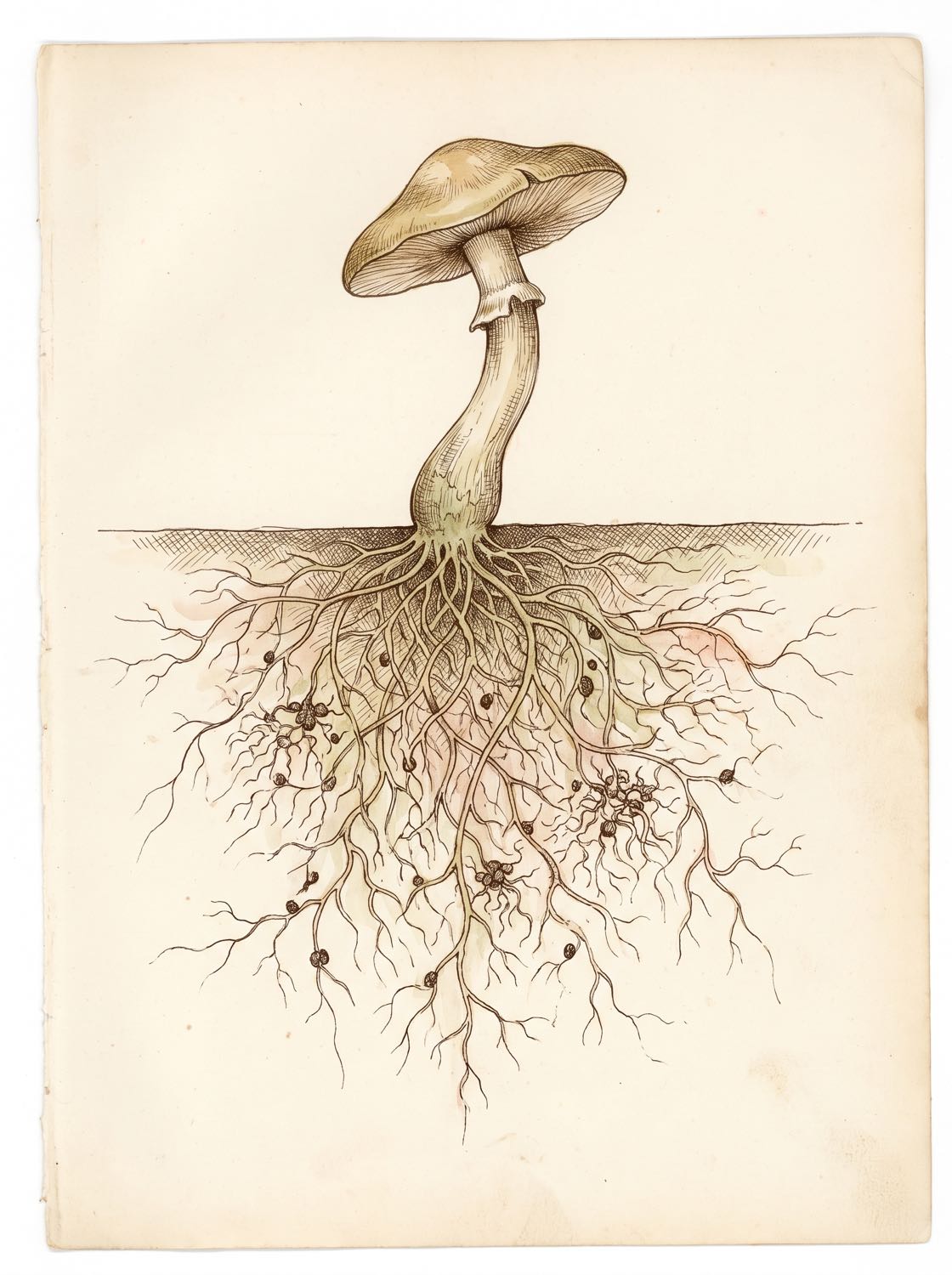
A founder-dependent business is a cut flower. It looks alive. It has no roots. It has been dying since the day it bloomed — slowly enough that you can spend twenty years watering the vase.
I know the underground layer because I spent a career in it. I was a big-firm litigator billing 3,500 hours a year until my body sent an invoice of its own. I built a company from zero to seven figures in nineteen months, and learned — expensively, twice — that supplying the engine without holding the structure is a certificate of captivity.
And I spent years beside a brilliant specialist, one of the best in the world at a very hard, very technical thing, who couldn’t reliably make his own payroll. He could see the numbers of any business except his own. What saved that firm wasn’t brilliance — his or anyone else’s. It was the day he said, out loud, that something wasn’t working, and let somebody open the drawer. After that, the fixes were almost embarrassingly ordinary: billing on a calendar, payment before an engagement starts, collections handled by someone who wasn’t too embarrassed to ask. Payroll never missed again. He handed his anxiety to a structure that could hold it, and got his genius back.
That’s the whole trade. Not spreadsheets — the exhale. And it only ever starts one way: with an owner who can say something is just not working while it’s still Tuesday-afternoon true instead of 3am-true, and who is willing to let the details be read. Every calm business I’ve ever watched get rebuilt started with that sentence. Not with a consultant.
So this is what I do now: I sit down with founders of established businesses and read the part nobody looks at — the paperwork, the terms, the cash rhythm, where your week actually goes.A soil test, not a sales call. A soil test. What grows out of it is a business with roots: one that runs without your hands in every corner, one that could be sold someday — or at least one that lets you leave for two weeks without doing the 3am math.
And here is what surprises founders most: the answer is rarely “sell more.” There is almost always money already in the business — earned but never collected, priced years below its worth, promised on terms nobody enforces because nobody wrote them down. Buried treasure, sitting in the exact drawer nobody wants to open. Finding it isn’t magic. It’s reading.
This site is my working notebook, kept in the open. The field notes here are how I think, published weekly, imperfect on purpose. If soil and roots strike you as a soft way to talk about money, we’ll probably frustrate each other — no hard feelings. If it reads like the first accurate description of your Sunday nights you’ve seen in a while: stay. Take what’s useful.
Nothing here will chase you. No popups, no countdowns, no funnel with your name on it.
Where it starts
It starts with The Owner’s Review. An afternoon of questions you have never been asked, alone, nobody watching — and at the end, two documents: one that tells you exactly which drawer to open, and one so honest it never leaves your hands. $497. It’s there when you’re ready.
— Susan Callender
The field notes go out every Tuesday. No pitch attached.
Added. Next Tuesday’s field note will land in your inbox.
Or write to me directly: susan@clickbridgeconsulting.com