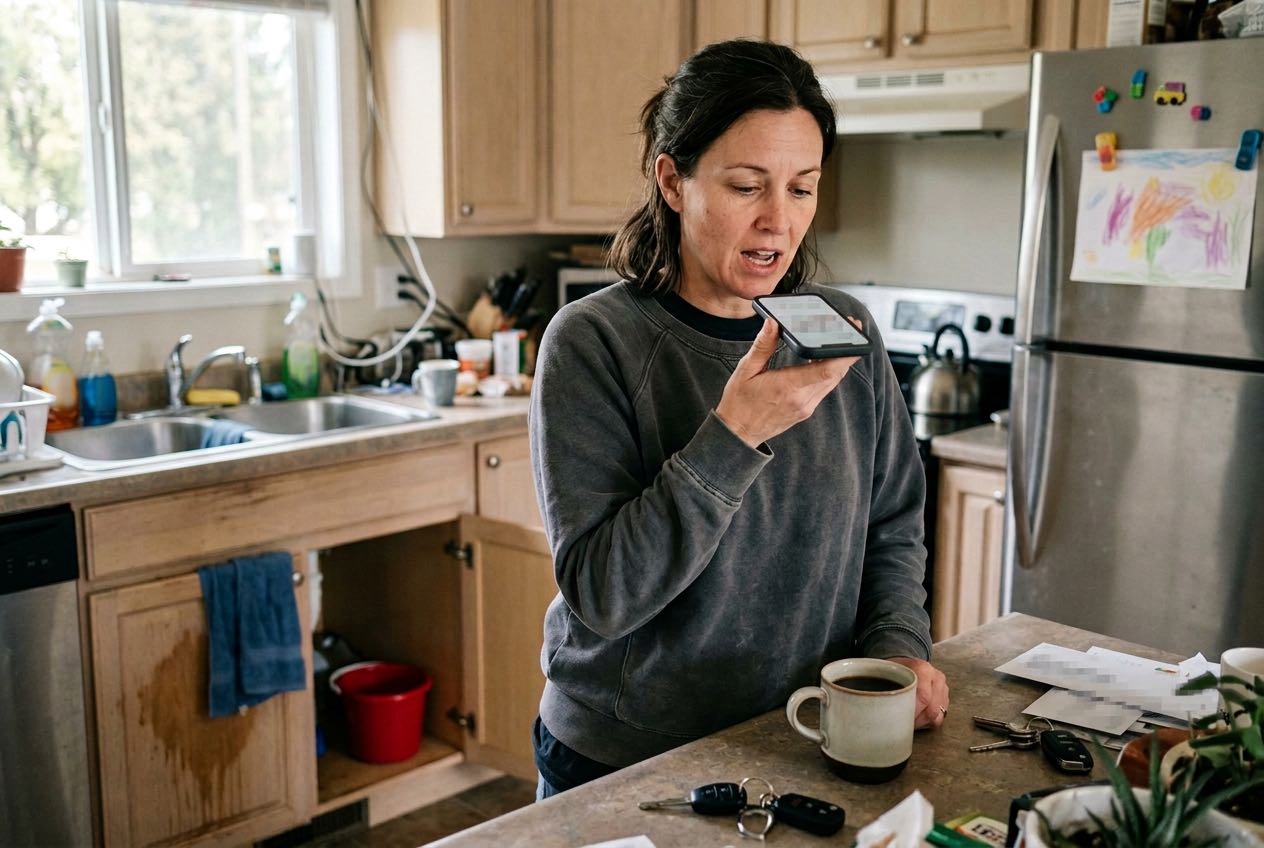
A homeowner across town asks her phone who to call for a plumber.
Three names come back. Yours isn’t one of them.
It has nothing to do with how good you are.
The short answer
An AI assistant recommends a business when it can find five plain things on that business’s own website: what you do, where you do it, when you’re open, roughly what it costs, and what you don’t do.
If those five aren’t written somewhere it can read, it won’t name you. And it won’t tell you it didn’t.
That’s the whole thing. The rest of this note is where that comes from and what to do this week.
A letter from a different world
Last week a newsletter landed in my inbox, written by Greg Isenberg, who’d spent 48 hours in San Francisco meeting with the people building the AI companies you keep hearing about. Founders, executives, people running companies worth billions. He writes for that crowd. He’s very good at it.
The letter was about thirty observations long. And as I read it, something caught my attention.
Five of those thirty observations apply directly to the person who owns the plumbing shop down the street. Or the HVAC company. Or the landscaping crew that’s been in town for fifteen years.
I don’t say that as a criticism. Most of the letter wasn’t written for her, and it doesn’t need to be. But the five that do reach her all arrive the same way: through her customer’s phone.
The dinner question
The line that stuck with me most came from a dinner in that letter. Someone asked a table of founders: “If a new model drops next month, does your company get better or worse?”
Half the table went quiet.
Now put a plumber at that table. Her honest answer is probably neither. A new AI model doesn’t make her better or worse at plumbing. But it does make her customers’ phones smarter at finding plumbers, and that’s the part nobody has explained to her yet.
The five that reach the local service owner
Here’s how each of those observations translates out of the founder’s room and into a real service business.
1. Your product now has to sell itself twice. In the newsletter, this referred to software: first the AI assistant picks it, then the human says yes.
For a service business, it’s the same. The assistant reads your pricing page, your service area, your hours. It skips the video on your homepage. Most local shops have a video on the homepage and none of the written plain facts.
2. Memory is where the loyalty lives. In the newsletter’s version, the AI model that remembers the most about you wins.
For a service business, you are the memory. Which jobs you take. What things typically cost in the older part of town. Why you won’t touch certain materials. None of that is written anywhere, which means nothing can read it and pass it along.
3. Fifteen years of customer records is the asset. Tech founders are realizing their data is worth more than their code. Your version is a QuickBooks file and maybe a shoebox of old invoices. Same asset. Just harder for anyone (or anything) to read.
4. Hourly billing is under pressure. The newsletter made the point that AI is making people dramatically faster, which squeezes anyone billing by the hour. Service businesses are starting to feel this too, mostly because customers’ expectations about speed and price are shifting. We covered this in August, and the six-job price sheet is where to start.
5. Everyone wants to connect their data, and then they see the mess. In the letter, founders discovered five versions of the same customer across different systems, Slack channels nobody searches, PDFs filed nowhere useful.
Your version is the phone, the truck, and the invoice book, each with a slightly different spelling of the same customer name. Same problem. Less jargon around it.
Five points. One route in. And nobody is going to call your shop and warn you it’s happening.
What’s actually being asked for
Go back to the five plain things. What you do. Where. When. Roughly what it costs. What you won’t do.
It’s also the first page of what a buyer asks for when they look at a business. It’s the same list.
The reason most businesses don’t sell is that everything a buyer would need to know lives in the owner’s head. The reason an AI assistant can’t recommend them is identical. An assistant can only pass along what’s written down, and “written down” turns out to be the same work that makes a business sellable.
So it’s the old job, with a second good reason to finally do it.
What I’d have to admit at that table
Before asking you to answer the dinner question, I owe you my own answer.
I read businesses like yours and tell owners what a buyer would see. So if the assistants got smarter next month, would they find this site more easily?
The honest answer is three out of five.
What I do is written down, though in my words rather than the words an owner would type into a phone. What it costs is there. What I’m not for is there, plainly.
Where I work isn’t on the site. Neither is what happens after you buy, or how fast. Those live in my head, and nothing can read them.
An assistant asked “who helps an owner in the Bay Area get a business ready to sell” would probably come up short, because the legible version of the work doesn’t exist yet.
I’m about to tell you to write things down. I haven’t finished writing mine.
That’s the honest answer. And it’s probably yours too.
The one that costs you, and you’ll never know it
Picture the morning it goes wrong.
It doesn’t look like anything.
A homeowner a few streets over asks her phone for a recommendation. Three names come back. She calls the second one. You never got a call to lose. There’s no missed call, no cold quote, no bad review. The job simply never existed on your end.
That’s what makes this different from every other way a service business loses work. You can’t notice it. There’s nothing to follow up on.
The move to prevent it is small and unglamorous: write the five things down, in plain language, on a page of your own website that an assistant could read out loud.
What that page looks like
Here’s a plain example. The names are made up; the shape is the point.
Alvarez Plumbing, Concord, CA
What we do: Residential plumbing: drain clearing, water heaters, leak and pipe work, fixture replacement.
Where: Concord, Walnut Creek, Pleasant Hill, Martinez.
Hours: Monday to Friday, 7am to 5pm. Same-day after-hours emergencies available at a higher rate quoted on the phone.
Starting prices: Drain clearing from $189. Water heater replacement from $1,650 installed. Leak diagnosis $125, credited toward the job.
What we don’t do: New construction, commercial work, septic systems.
That’s it. Forty seconds to read. An assistant can answer “who does water heaters in Walnut Creek and what does it cost?” from that page alone. A potential buyer can answer “what is this business?” from it too.
One page solves both problems.
Three things to do this week
1. Ask the dinner question, in your own version. If my customers’ phones got smarter next month, would they find us more easily? Ask it out loud, with whoever answers your business phone. Her answer is usually the most accurate one in the room.
2. Write the five things on one page. What you do. Where. When. Starting prices. What you refuse. Plain words. On your own site, not only on a directory listing that could change its rules without telling you.
3. Get your customer records into one place, with one spelling per customer. Before anyone asks to connect to them. It’s your asset. It reads a lot better as one organized file than scattered across three systems.
Check it in a minute
Before you rewrite anything, find out what an assistant can actually see on your site right now.
Can an Agent Find You? reads your site the way a customer’s phone would and shows which of the five facts it found, which it couldn’t, and the one thing you’d fix first.
It’s free. It takes about a minute. It reads what’s actually there, not what you meant to put there.
The line
An assistant can only recommend what’s written down. And written down is what makes a business worth buying.
Common Questions
How do I get my business recommended by ChatGPT?
Make five plain facts readable on your own website: what you do, where you do it, when you’re open, starting prices, and what you don’t do. AI assistants read text, not design. If a fact isn’t in plain words on a page the assistant can reach, it can’t use it.
Does an AI assistant read my Google listing or my website?
Both, when it can. But a directory listing can change its format or its rules without telling you. Your own site is the copy you control, so put the five facts there first, and keep your listing matching it.
What is AI local search?
It’s a customer asking an assistant who nearby does a certain job, instead of typing into a search box. The assistant returns a short list built from what it could read. Businesses that are easy to read get named more often.
Do I need to learn SEO or hire an agency for this?
Not for the five facts. That’s writing, not marketing, and it takes an afternoon. Many agencies selling “AI visibility” are selling the same list with a longer name.
Is being easy for AI to read the same as being ready to sell my business?
Largely, yes. A buyer’s first questions are the same five: what does the business do, where, what does it charge, and what depends on the owner personally. Writing it down serves both goals at once.
Greg Isenberg’s newsletter is quoted once and linked above; the rest is paraphrase. Alvarez Plumbing is an invented example. Education only, not financial, tax, or legal advice.
Get next Tuesday’s essay. One a week on the business of your business. No pitch, no course, no funnel, just the next layer of the fog, taken apart.
You’re on the list. See you Tuesday.